
Ray-finned fish
Black Trevally
闊步鰺Caranx lugubris
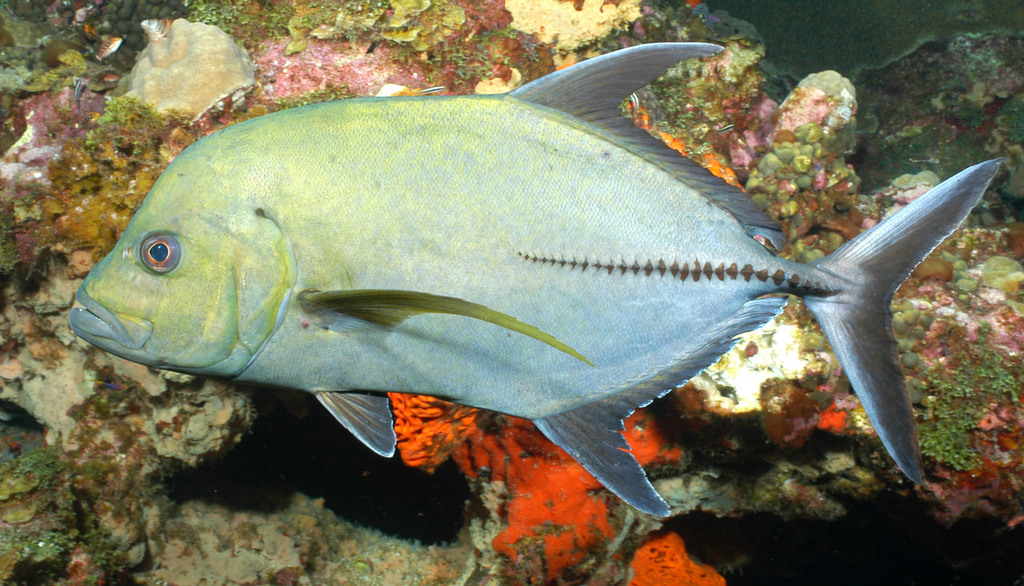
Black Trevally: quick facts
Black Trevally (Caranx lugubris) is native to Taiwan (and also found elsewhere). It belongs to the family Carangidae, order Carangiformes (ray-finned fish). IUCN: LC. FormosaWatch's map has 1 record of it in Taiwan (1 sightings), in 2006. Most often in Taitung County; most records are from November.
Caranx lugubris, the black jack, black trevally, black kingfish, coal fish or black ulua, is a species of large ocean fish in the jack family Carangidae. The species has a circumtropical distribution, found in oceanic, offshore waters of the tropical zones of the Pacific, Atlantic and Indian Oceans. The species is particularly prevalent around offshore islands such as the Caribbean islands in the Atlantic, Hawaii and French Polynesia in the Pacific and the Seychelles and Maldives in the Indian Ocean. Black jack are rare in shallow waters, preferring deep reefs, ledges and seamounts in clear waters. The species is easily distinguished by its black to grey fins and jet black scutes, with the head having a steep profile near the snout. The largest recorded length is 1 m and weight of 17.9 kg. The black jack lives either individually or in small schools, and is known to school with other species. It is a predatory fish, taking a variety of fish, crustaceans and molluscs as prey. Sexual maturity is reached at 34.6 cm in females and 38.2 cm in males, with spawning taking place between February and September in the Caribbean. The early life history of the species is very poorly understood. Black jack are of high importance to many island fisheries, but are rarely encountered in most continental fisheries. The species has a reputation as a gamefish, and is variably considered a terrible or excellent food fish, although several cases of ciguatera poisoning have been attributed to the species. The species was initially named Caranx ascensionis by Georges Cuvier, however several issues with the use of this name have seen Felipe Poey's name Caranx lugubris become the valid scientific name.
From Wikipedia: Caranx lugubris, CC BY-SA 4.0
How is the Black Trevally classified?
- KingdomAnimalia (Animals)
- PhylumChordata
- SubphylumVertebrata
- ClassActinopterygii
- SuperorderAcanthomorpha (Spiny-rayed fishes)
- OrderCarangiformes
- SuborderCarangoidei (Jacks, Remoras, and Allies)
- FamilyCarangidae (Jacks)
- SubfamilyCaranginae (Trevallies and Kingfishes)
- GenusCaranx
- SpeciesCaranx lugubris
What is the Black Trevally called?
- Chinese name
- 闊步鰺
- English name
- Black Trevally
- Scientific name
- Caranx lugubris
Is the Black Trevally native, endemic or protected?
- Status in Taiwan
- native to Taiwan (and also found elsewhere)
- Protected
- —
- IUCN
- LC
Where is the Black Trevally found in Taiwan?
Counties and cities where FormosaWatch's map has records of it (by nearest township):
- Taitung County1
When is the Black Trevally seen most?
- JJanuary 0
- FFebruary 0
- MMarch 0
- AApril 0
- MMay 0
- JJune 0
- JJuly 0
- AAugust 0
- SSeptember 0
- OOctober 0
- NNovember 1
- DDecember 0
- All records
- 1
- Sightings (iNaturalist)
- 1
- Years
- 2006
Species related to the Black Trevally
Same genus Caranx
Same family Carangidae
Sources
Names, status and habitat from TaiCOL (CC BY 4.0); records from TaiRON via GBIF (CC BY 4.0) and iNaturalist (each observer’s own licence). Full credits
Month by month
Members can see this species month by month for any year, including sightings and roadkill our members have reported. Accounts are free.
Roadkill by month, all years
Show the numbers
| January | 0 |
|---|---|
| February | 0 |
| March | 0 |
| April | 0 |
| May | 0 |
| June | 0 |
| July | 0 |
| August | 0 |
| September | 0 |
| October | 0 |
| November | 0 |
| December | 0 |
Roadkill by year
Show the numbers
| 2011 | 0 |
|---|---|
| 2012 | 0 |
| 2013 | 0 |
| 2014 | 0 |
| 2015 | 0 |
| 2016 | 0 |
| 2017 | 0 |