
Birds
Eastern Imperial Eagle
白肩鵰Aquila heliaca
Eastern Imperial Eagle: quick facts
Eastern Imperial Eagle (Aquila heliaca) is native to Taiwan (and also found elsewhere). It belongs to the family Accipitridae, order Accipitriformes (birds). It lives on land only, and is not found in the sea. It is protected under Taiwan's Wildlife Conservation Act (Class I · Endangered). IUCN: VU; CITES Appendix I. FormosaWatch's map has 9 records of it in Taiwan (9 sightings), between 2017 and 2018. Most often in Kinmen County; most records are from February.
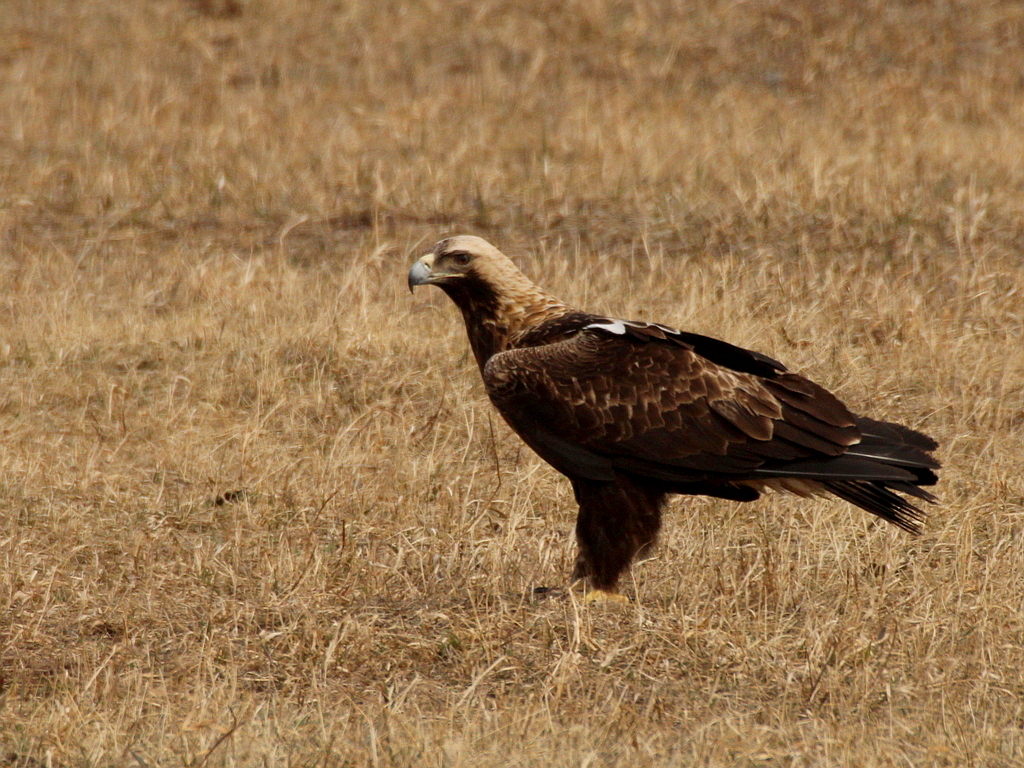
The eastern imperial eagle is a large bird of prey that breeds in southeastern Europe and extensively through West and Central Asia. Most populations are migratory and winter in northeastern Africa, the Middle East and South and East Asia. Like all eagles, the eastern imperial eagle is a member of the family Accipitridae. Furthermore, its feathered legs mark it as a member of the subfamily Aquilinae. It is a large, dark-colored eagle, with a resemblance to other members of the genus Aquila, but it is usually the darkest species in its range. It is an opportunistic predator that mostly selects smallish mammals as prey but also a fairly large proportion of birds, reptile and other prey types, including carrion. Compared to other Aquila eagles, it has a strong preference for the interface of tall woods with plains and other open, relatively flat habitats, including the wooded mosaics of the steppe. Normally, nests are located in large, mature trees and the parents raise around one or two fledglings. The global population is small and declining due to persecution, loss of habitat and prey. It has therefore been IUCN Red Listed as Vulnerable since 1994.
From Wikipedia: Eastern imperial eagle, CC BY-SA 4.0
Protected or sensitive: records are shown only as a blurred square about 10 km across.
How is the Eastern Imperial Eagle classified?
- KingdomAnimalia (Animals)
- PhylumChordata
- SubphylumVertebrata
- ClassAves
- OrderAccipitriformes
- FamilyAccipitridae (Hawks, Eagles, and Kites)
- SubfamilyAquilinae (Typical Eagles and Hawk-Eagles)
- GenusAquila
- SpeciesAquila heliaca
What is the Eastern Imperial Eagle called?
- Chinese name
- 白肩鵰
- English name
- Eastern Imperial Eagle
- Scientific name
- Aquila heliaca
Is the Eastern Imperial Eagle native, endemic or protected?
- Status in Taiwan
- native to Taiwan (and also found elsewhere)
- Protected
- Yes: Class I · Endangered
- IUCN
- VU
- CITES
- Appendix I
- Locations
- Protected or sensitive: records are shown only as a blurred square about 10 km across.
Does the Eastern Imperial Eagle live on land or in the sea?
It lives on land only, and is not found in the sea.
- Land
- Fresh water
- Brackish water (estuaries)
- Sea
Source: TaiCOL (Catalogue of Life in Taiwan).
Where is the Eastern Imperial Eagle found in Taiwan?
Counties and cities where FormosaWatch's map has records of it (by nearest township):
- Kinmen County9
When is the Eastern Imperial Eagle seen most?
- JJanuary 3
- FFebruary 5
- MMarch 1
- AApril 0
- MMay 0
- JJune 0
- JJuly 0
- AAugust 0
- SSeptember 0
- OOctober 0
- NNovember 0
- DDecember 0
- All records
- 9
- Sightings (iNaturalist)
- 9
- Years
- 2017–2018
Species related to the Eastern Imperial Eagle
Sources
Names, status and habitat from TaiCOL (CC BY 4.0); records from TaiRON via GBIF (CC BY 4.0) and iNaturalist (each observer’s own licence). Full credits
Month by month
Members can see this species month by month for any year, including sightings and roadkill our members have reported. Accounts are free.
Roadkill by month, all years
Show the numbers
| January | 0 |
|---|---|
| February | 0 |
| March | 0 |
| April | 0 |
| May | 0 |
| June | 0 |
| July | 0 |
| August | 0 |
| September | 0 |
| October | 0 |
| November | 0 |
| December | 0 |
Roadkill by year
Show the numbers
| 2011 | 0 |
|---|---|
| 2012 | 0 |
| 2013 | 0 |
| 2014 | 0 |
| 2015 | 0 |
| 2016 | 0 |
| 2017 | 0 |